



Both Gulf nations, Saudi Arabia and the UAE, have faced cyberattacks in the first half of 2026. The cyber hubs have used advanced AI tools to destroy critical national infrastructure, municipal services, and corporate networks across both Gulf nations. Gulf AI Cyberattack Threats
As per the report published by the Industry Telemetry and Official Cybersecurity Disclosure within the six months, a destructive digital cyberattack has been done to destroy a regional economy.
During the duration of cybersecurity monitoring teams’ operation, millions of intrusion attempts have been recorded. The attacks comprised automated reconnaissance scripts, AI-powered phishing campaigns, and malware designed to penetrate the security networks of highly recognized businesses and organizations.
The dramatic shift in regional risk exposure stems from the rapid expansion of digital government services, financial technologies, and industrial automation across the Gulf Cooperation Council. Threat actors have shifted from basic social engineering to automated, multi-vector intrusion campaigns that intentionally target soft entry points, including vendor access portals, cloud extensions, and unpatched perimeter hardware.
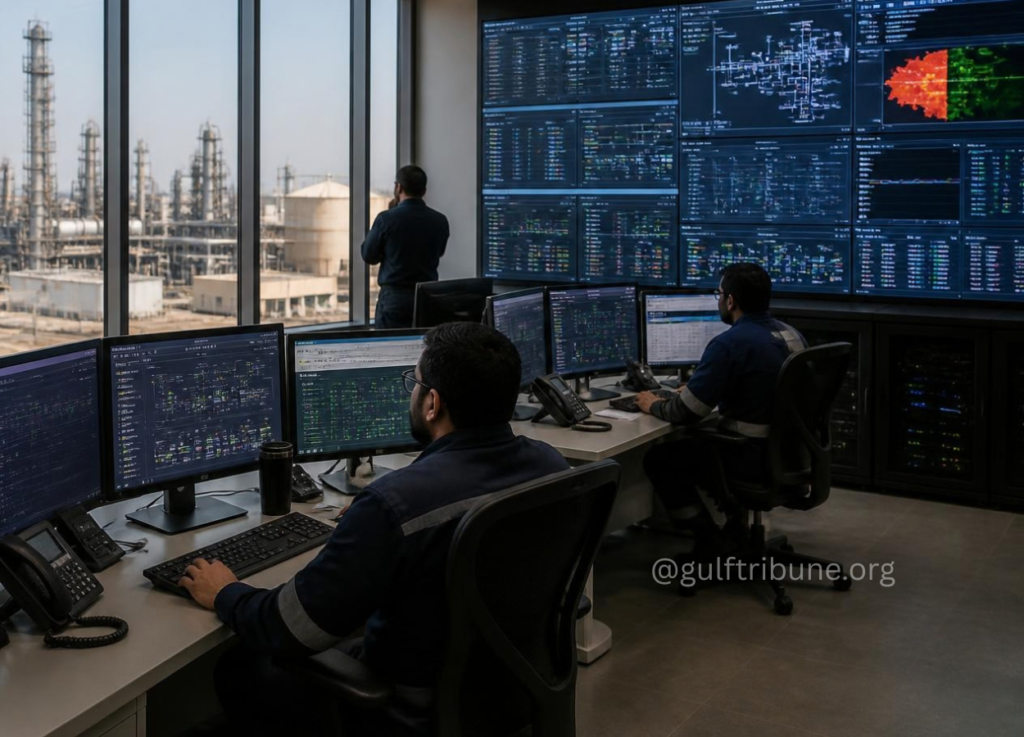
In the UAE alone, security research teams blocked over five million web-based attack vectors during the first half of the year, while national authorities neutralized targeted intrusion attempts aimed at aviation, energy, and educational platforms. Concurrently, ransomware syndicates focused heavily on Saudi industrial and enterprise assets, establishing dedicated databases of internet-facing network devices to execute persistent extortion campaigns.
Emerging artificial intelligence capabilities have fundamentally reshaped the regional attack landscape, enabling malicious groups to scale operations while drastically reducing initial deployment costs. Threat actors are routinely utilizing large language models to construct adaptive execution scripts, craft convincing localized lures, and identify software vulnerabilities in real time.
Regional security leaders emphasize that human error remains a primary vulnerability, with standard credential harvesting and deceptive user interactions accounting for the vast majority of initial enterprise breaches. Furthermore, operational technology environments across the GCC face heightened exposure as legacy field equipment and industrial control systems become increasingly linked to broader corporate IT networks.
In response to the expanding threat matrix, governments and enterprise entities across the UAE and Saudi Arabia are rapidly scaling up defensive measures, investing in AI-driven threat detection systems, and enforcing stricter regulatory compliance frameworks. The UAE Cybersecurity Council and regional defense networks have elevated operational coordination, establishing real-time monitoring protocols to isolate suspicious network activity before service disruptions occur. Defense experts stress that protecting vital infrastructure requires a holistic strategy combining automated detection, continuous vulnerability patching, and comprehensive employee security awareness training to counter complex digital threats. Gulf Tribune